



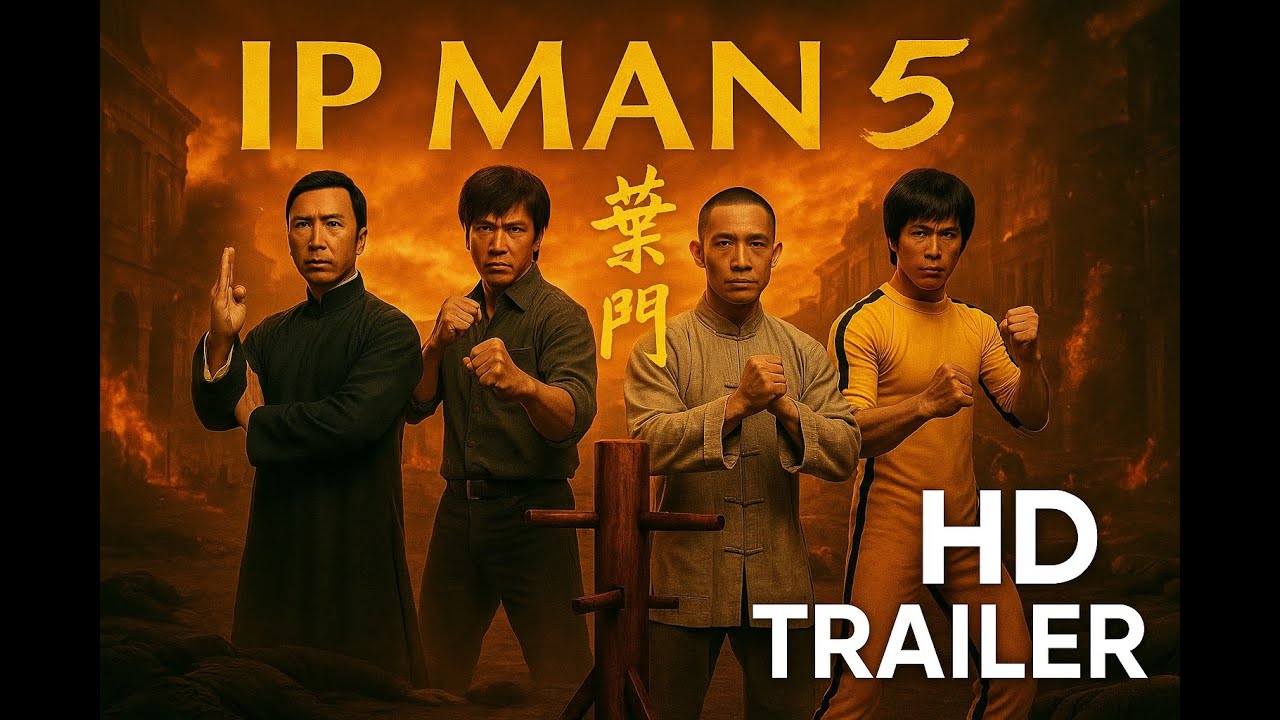
A Legend Declared Finished, Then Quietly Reopened
For many fans, Ip Man 4: The Finale closed the book with dignity. The story ended not with spectacle, but with acceptance, illness, and the calm authority of a life fully lived. That is why the very idea of Ip Man 5 feels both thrilling and dangerous. To revisit a character whose death carried thematic weight is to risk undoing what made the farewell meaningful.

Yet the Ip Man series has always thrived on contradiction. It is at once intimate and mythic, historically grounded and operatically heightened. The announcement that Donnie Yen may return, with Wilson Yip reportedly involved, does not feel like a cynical reboot so much as a careful reopening of a legend that still has something to say.

What Ip Man Has Always Been About
Despite its reputation for bruising action, the heart of the franchise has never been violence. These films are about restraint, humility, and cultural survival. Ip Man does not fight because he wants to, but because circumstances leave him no moral alternative.

- Wing Chun as philosophy, not just technique
- Honor without arrogance
- Strength defined by control
This thematic clarity is what separates the series from lesser martial arts franchises. Any fifth chapter must justify its existence not through escalation, but through reflection.
The Challenge of Bringing Ip Man Back
The central question surrounding Ip Man 5 is not whether it can be exciting, but whether it can be honest. Ip Man died. The audience mourned him. Reversing that fact outright would cheapen the emotional architecture of the saga.
The more intriguing possibilities lie elsewhere:
- Flashbacks to unseen chapters of Ip Man’s life
- A story framed through students and legacy
- A spiritual or philosophical continuation rather than a literal resurrection
If the filmmakers choose subtlety over spectacle, the character can return without violating the truth of his ending.
Donnie Yen: The Weight of a Career
It is impossible to separate Ip Man from Donnie Yen himself. Over four films, Yen did more than portray a historical figure; he reshaped the global image of Chinese martial arts cinema. His performance aged with the character, growing quieter, heavier, and more introspective.
By the time of the fourth film, Yen moved like a man carrying memory in his bones. Every block and counter felt earned. If he returns for Ip Man 5, it should not be to prove physical dominance, but to underline wisdom, loss, and transmission.
Action Expectations: Precision Over Excess
The Ip Man series has never relied on chaotic editing or digital trickery. Its action works because it is legible, rhythmic, and purposeful. The rumored return to classic Hong Kong choreography is encouraging.
Likely hallmarks include:
- Clean, rapid chain punches
- Wooden dummy sequences used as character moments
- Multi-opponent fights staged with clarity and geography
If anything, Ip Man 5 should slow down, allowing each movement to communicate intention rather than sheer speed.
Legacy, Bruce Lee, and the Next Generation
No discussion of Ip Man is complete without acknowledging Bruce Lee. Previous entries handled this relationship with surprising restraint, portraying Lee not as a symbol, but as a restless student shaped by tradition and rebellion.
A fifth film could explore this legacy more fully, not through imitation, but through influence. How does a philosophy survive when the world modernizes faster than tradition can adapt? That question feels as relevant now as it did in the historical settings of the earlier films.
Visual Style and Emotional Tone
The best Ip Man films balance elegance with grit. The cinematography favors natural light, lived-in spaces, and physical proximity. Music swells sparingly, allowing silence to do much of the emotional work.
If Ip Man 5 succeeds, it will not end with a roar, but with a pause. A moment where the audience understands that what mattered was never the fight, but what was protected by it.
Final Thoughts
Ip Man 5 walks a narrow path between tribute and redundancy. The ingredients are there for something meaningful: a defining actor, a disciplined director, and a character rooted in moral clarity. The danger lies in mistaking resurrection for relevance.
If the film treats Ip Man not as a body to be revived, but as a legacy to be examined, it may yet earn its place. Legends do not fade when they are remembered with care. They fade when they are repeated without understanding.
Anticipation Verdict
Provisional Rating: 9/10 (based on potential)
Not because the film promises louder action, but because it dares to ask whether an ending can be honored by one final reflection.